Equip yourself with industry-leading CRM tools and premium NISM certification training to scale your mutual fund distribution business.

A comprehensive Customer Relationship Management (CRM) platform built specifically for Mutual Fund Distributors to automate sales, track portfolios, and close more leads.

Comprehensive certification and skill-based training programs designed to help financial professionals master mutual funds, portfolio management, and client acquisition.
Financial decisions are rarely simple. Everyone wants to save, but few know how much they need to invest, for how long, or at what return to meet a goal. The Financial Planning Calculator (With & Without Inflation) on WebClass.in converts that uncertainty into precision.
It is not one calculator but a complete digital toolkit. Within the same page you can open a Simple SIP Calculator for monthly investments, a Step-Up SIP Calculator for growing contributions, a Lump-Sum Investment Calculator for one-time deposits, a Total Return Calculator (SIP + Lump Sum) for combined strategies, and a Delayed Investment Calculator to reveal the cost of waiting.
Every tool is also available in an inflation-adjusted mode, allowing you to compare nominal versus real returns. These include the SIP Calculator (With Inflation), Step-Up SIP Calculator (With Inflation), Lump-Sum Calculator (With Inflation), Total Return Calculator (SIP + Lump Sum With Inflation), and the Cost of Delayed Investment Calculator (With Inflation).
The planner also includes advanced modules such as the Step-Up SIP Calculator (Percent) and the Step-Up SIP Calculator (Percent With Inflation), giving investors more flexibility in modeling growth-linked contribution patterns.
When you first open the planner, you’ll notice how quickly numbers become meaningful. Enter a few inputs—amount, rate, years—and within seconds you can see the corpus, total invested amount, and inflation-adjusted purchasing-power value.
This immediate feedback helps you visualize progress toward any goal—whether it’s a child’s education, retirement, or long-term wealth creation—making financial planning simpler, clearer, and far more actionable.
Inflation, lifestyle upgrades, and changing market cycles have made manual calculations outdated. In 2026, an investor needs digital precision. The WebClass.in calculators use standard compound-interest and present-value formulas validated by certified financial planners, ensuring that projections reflect real-world compounding rather than guesswork.
Using these tools gives three major advantages. First, they save time; complex future-value computations are produced instantly. Second, they improve accuracy; each calculator applies exact mathematical logic, eliminating human error. Third, they enhance understanding; by adjusting one variable—say, tenure or return—you immediately see how your future wealth changes. That interactive learning is impossible with static spreadsheets.
For financial advisors and mutual-fund distributors, these calculators double as presentation aids. Clients grasp the power of compounding visually and commit to disciplined investing faster. For individual investors, they replace emotion with evidence.
A decade ago, many savers invested arbitrary amounts: “Let me put ₹2 lakh somewhere this year and see what happens.” Modern financial planning reverses that approach. You start with a goal—for example, “I need ₹50 lakh for my child’s college in 15 years”—and then work backward to discover the required monthly SIP or lump-sum today. The Financial Planning Calculator performs that backward journey instantly.
Each input field has a purpose.
Investment Amount represents the cash you commit, whether monthly through a SIP Calculator or once through a Lump-Sum Calculator.
Expected Return converts historical fund performance into an annualized rate and is applied across all tools, including Step-Up SIP and SIP + Lump Sum Total Return.
Tenure determines compounding periods, impacting both monthly SIP projections and one-time lump-sum projections.
Inflation Rate transforms nominal results into real, inflation-adjusted outcomes, especially in tools like the SIP Calculator (With Inflation), Lump-Sum Calculator (With Inflation), or SIP + Lump Sum Total Return (With Inflation).
Together they create a clear picture of your financial trajectory. Instead of a vague hope, you now have a measurable path.
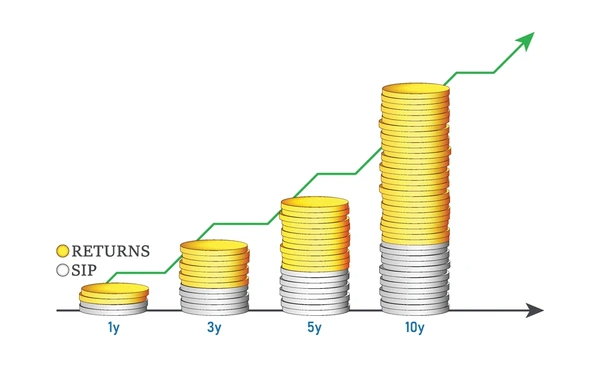
Compounding is the reason small sums turn into large fortunes. When your investment earns returns, those returns themselves start earning. Each calculator on WebClass.in — from the SIP Calculator to the Lump-Sum Calculator, Step-Up SIP Calculator, and SIP + Lump Sum Total Return Calculator — uses monthly compounding to replicate how mutual funds actually accumulate value.
The concept is simple but profound:
The longer you stay invested, the steeper that curve becomes. A ₹5,000 SIP at 12% for 20 years can create nearly ₹49 lakh through the SIP Calculator, but for 25 years the same SIP can exceed ₹85 lakh. Nothing else in personal finance delivers such reliable multiplication.
A Systematic Investment Plan is the cornerstone of disciplined investing. It divides a big goal into manageable monthly payments and leverages market fluctuations through rupee-cost averaging. The Simple SIP Calculator helps you predict the future value of those payments.
The calculator applies the standard SIP formula: Future Value = P × [(1 + r)n – 1]/r × (1 + r), where P is your monthly contribution, r is the monthly rate of return, and n is the total number of months.
You don’t need to understand the algebra—the tool does the math instantly. What matters is the principle: consistency and time generate exponential growth.
Imagine investing ₹5,000 per month for 10 years at 12% annual return. The calculator instantly displays a future value around ₹11.6 lakh. You contributed ₹6 lakh and earned about ₹5.6 lakh in profit. Extend the tenure to 20 years and the corpus leaps to ₹49 lakh—proof that time amplifies returns more than amount.
Without inflation adjustment, numbers can be misleading. If inflation averages 6%, the real return on that 12% fund is roughly 5.66%. When you toggle “With Inflation,” the calculator automatically displays both nominal and real outcomes. The ₹49 lakh becomes about ₹26 lakh in today’s money. Use the SIP Calculator (With Inflation) to view real purchasing-power projections directly.
That difference reminds investors to aim higher than nominal goals.
Frequent recalculation—perhaps once a year—keeps your plan aligned with market reality.
Does SIP guarantee profit?
No. SIP is a method, not a product. It reduces risk through averaging
but still depends on fund performance.
What if markets fall?
Falling markets actually help; you buy more units for the same rupee,
improving long-term returns.
Can I change my SIP amount?
Yes. Increase or pause anytime. The calculator instantly shows new
projections.
Should I stop during emergencies?
Prefer reduction or pause instead of complete stoppage; restarting
later often costs more than temporary adjustments.
By mastering these basics, you lay the groundwork for advanced planning using the Step-Up SIP Calculator.
Occasionally you receive a bonus, inheritance, or business profit. Instead of parking it idly, use the Lump-Sum Investment Calculator to see how it can multiply over time. Enter your amount, expected annual return, and years of investment. The projection shows both nominal and inflation-adjusted future values using the Lump-Sum Calculator (With Inflation).
A one-time ₹10 lakh at 10% for 15 years becomes roughly ₹42 lakh. Adjust for 6% inflation and the real value drops to ₹22 lakh—still almost doubling purchasing power. Understanding this contrast encourages longer holding periods and realistic goal setting.
Good habits for lump-sum investors include: starting early, reinvesting dividends, diversifying across asset classes, and resisting the urge to redeem prematurely. The calculator quantifies how patience beats timing every single time.
Most people own more than one investment type. Some money flows monthly via SIPs; other chunks enter occasionally. The Total Return Calculator merges all such contributions and computes the grand result. It is particularly useful for financial advisors preparing holistic reports or investors monitoring combined mutual-fund and lump-sum growth.
By inputting each element—SIP amount, frequency, lump-sum size, return rate, and tenure—you can observe how multiple cash flows cooperate to reach the same goal faster. It’s satisfying to see that adding a single ₹2 lakh lump-sum early in your SIP journey might shave several years off your retirement target. For inflation-adjusted projections, the Total Return Calculator (With Inflation) provides real-value analysis.
Use this calculator whenever you modify your portfolio so your expectations remain grounded in mathematics, not optimism.
The cost of delay is invisible but immense. Every month you postpone investing is a month of compounding lost forever. The Delayed Investment Calculator makes this painfully clear by comparing two scenarios—starting today versus starting later.
Input your SIP amount, expected return, investment horizon, and the delay period in months or years. The result shows how much less wealth you’ll build because of the wait. Often the figure is shocking. A three-year delay in a ₹5,000 SIP for 20 years at 12% costs about ₹16 lakh in final corpus. For inflation-adjusted insights, use the Cost of Delayed Investment Calculator (With Inflation).
The moral is simple: the best time to invest was yesterday; the next best time is today.
Most investors focus only on the number they see on paper—the nominal return. Ten percent, twelve percent, sometimes even more. Yet what truly matters is how much purchasing power those numbers represent after prices rise. A financial plan that ignores inflation is like a ship sailing without a compass; it looks fine until you realize you’re drifting off course.
Inflation-adjusted calculators on WebClass.in bridge this gap. Every calculator on the page— SIP (With Inflation), Step-Up SIP (With Inflation), Lump-Sum (With Inflation), Total Return (With Inflation), and Delayed Investment (With Inflation) — has a toggle to include inflation.
When switched on, the algorithm reduces nominal returns to “real
returns,” using the formula:
Real Return = (1 + Nominal Return) / (1 + Inflation Rate) –
1.
It then re-computes your corpus in today’s money.
If you project ₹1 crore in 20 years at 12%, the figure feels enormous. But with inflation at 6%, that corpus buys what ₹31 lakh buys today. Suddenly the goal feels smaller, yet more realistic. This awareness leads you to save slightly more, invest slightly longer, or target better asset allocation—adjustments that protect your lifestyle decades ahead.
Inflation-adjusted tools are especially vital for retirement and education planning because these goals stretch across 10–30 years, during which even moderate inflation silently halves value.
The nominal return is the raw growth percentage a fund or deposit reports. The real return is what remains after accounting for inflation. If a mutual fund delivers 10% and inflation runs at 6%, your real gain is only 3.77%.
Understanding this difference changes behaviour in several ways:
When you compare “with” and “without” inflation projections side by side on WebClass.in, the insight is immediate: nominal growth looks glamorous, real growth looks truthful.
Retirement is the longest and most inflation-sensitive goal. Expenses don’t vanish after 60; they often rise because of healthcare and lifestyle costs. Using the SIP Calculator (With Inflation), you can estimate how much monthly contribution ensures a specific income stream later. Enter your desired monthly pension in today’s value, add inflation and expected return, and the calculator reveals the SIP required.
Pair it with the Delayed Investment Calculator or the Delayed Investment Calculator (With Inflation) to see why starting five years earlier can double your retirement comfort.
Education costs grow faster than headline inflation—typically 8–10%. A degree that costs ₹20 lakh today may cost ₹40–45 lakh in 10 years. With the Step-Up SIP Calculator, you can begin modestly and increase annually with your salary. The inflation module ensures your projections remain realistic even as tuition rises.
Property prices also inflate. Use the Lump-Sum Calculator (With Inflation) to estimate the corpus you’ll have in five to eight years for a down payment. If the real value falls short, the tool instantly shows how much extra monthly SIP bridges the gap.
For long-term wealth goals, combine SIPs and lump-sums in the Total Return Calculator. The output shows nominal and real corpus along with total gain. Watching that real-return figure rise year after year is motivating; it transforms saving into a purposeful journey toward financial freedom.
Each calculator is powerful alone, but together they form a complete ecosystem. A typical progression looks like this:
This integrated approach makes your personal finance strategy dynamic, not static. You see how one decision affects another, allowing course-correction before it’s too late.
Even with good calculators, human behaviour can sabotage results. The most frequent errors include:
Recognizing these traps early ensures the numbers generated by WebClass.in’s calculators translate into real success, not just digital optimism.
To get the most from the suite:
Consistency with these habits creates a self-correcting financial system: your plan adjusts as life changes.
Financial planning isn’t about one perfect prediction; it’s about continuous calibration. The Financial Planning Calculator (With & Without Inflation) gives you the instruments to measure, compare, and correct. When used regularly, it evolves into a personal dashboard for your financial life.
By mastering each component—SIP, Step-Up, Lump-Sum, Total Return, Delayed Investment—and applying inflation adjustment, you gain three priceless advantages: clarity, control, and confidence. You know where you stand, what it will take to reach your goals, and how inflation may alter the path.
WebClass.in’s calculators transform abstract numbers into actionable insight—helping investors, advisors, and families make money decisions based on data, not emotion.
This article has been powered by WebClass.in. Explore their training, research and IT solutions in the Mutual Fund Sector at mfd.webclass.in. You can view innovative, insightful, factual and daily updated details about Mutual Fund Schemes at their inhouse research portal — research.webclass.in and view our training offerings in the field of Mutual Funds at training.webclass.in and also attempt latest quizzes on NISM VA, PMS among other Mutual Fund topics at quiz.webclass.in. Connect with us at operations@webclass.in or call us at 8910492919